Why we stopped saying “made by hand”
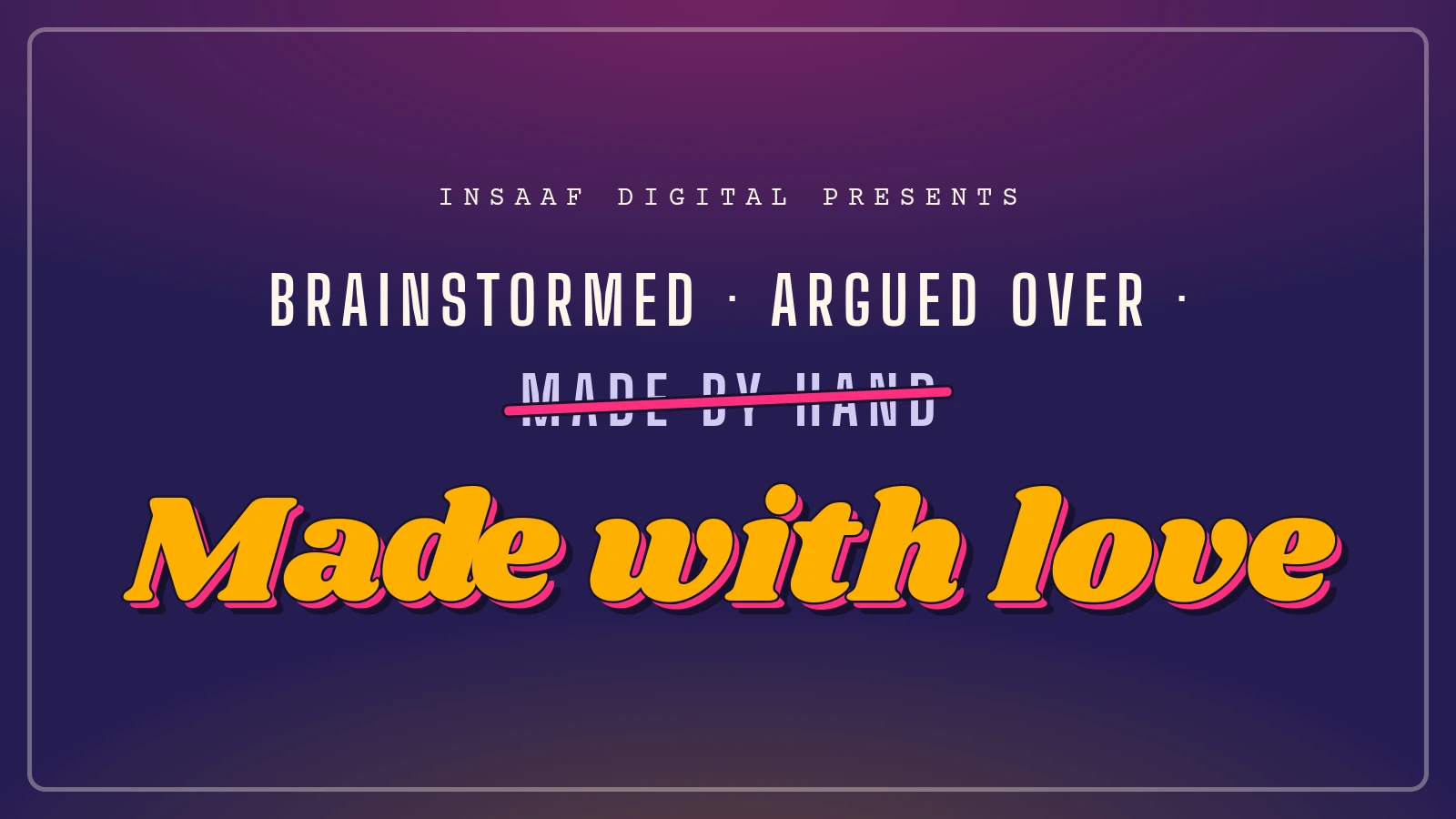
We recently changed one line on our website. The poster beside our founder’s note used to read “Brainstormed · Argued over · Made by hand”. Now the last part says “Made with love”.
“By hand” wasn’t true. We use AI tools every day, and we rely on them heavily for first drafts. Our name, Insaaf, means justice. To us, doing justice to someone’s work starts with being honest and transparent about how it’s made, whatever that costs. That’s why this is our first post.
Honesty costs a little. Getting caught costs more.
Honesty does cost something. In 13 experiments with more than 5,000 people, researchers at the University of Arizona found that trust fell whenever people disclosed using AI. Clients trusted graphic designers 20% less once the designers said they had used it. Softer wording, such as saying AI was only used for proofreading, didn’t stop the drop.
The same research found something worse: trust fell further when someone else revealed the AI use. We’d rather pay the smaller price up front. So here’s exactly how we work, and the research behind it.
People want to know how the work was made
Almost everyone in our industry uses AI now. In Orbit Media’s 2026 survey of 1,042 content marketers, 92% said they use AI for blogging, up from almost none three years earlier.
The people reading all that content want to know. In a Pew Research Center survey of 5,023 US adults, 76% said it was extremely or very important to be able to tell whether pictures, videos and text were made by AI or by people. More than half (53%) weren’t confident they could.
Google’s guidance on helpful content makes the same point. It says it’s “helpful to readers to know how a piece of content was produced”, and asks whether the use of AI is “self-evident to visitors through disclosures or in other ways”.
The ideas still start in a room
Most of our work starts with a brainstorm. We don’t put a client’s brief straight into an AI tool. People read every brief and work through it. Then we brainstorm ideas together and hold a strategy session, all before any drafting begins.
There’s a reason the start stays human. Across five experiments published in Nature Human Behaviour in 2025, Wharton researchers found that ChatGPT made individual ideas more creative but made a group’s ideas less varied. In one test, people invented toys from a brick and a fan. Among those using ChatGPT, 94% of the ideas shared overlapping concepts, and nine people independently named their toy “Build-a-Breeze Castle”. The ideas people came up with on their own were all different.
When everyone starts from the same tools, the work drifts towards the same place. What matters most now is taste, foresight and direction, and those come from people.
AI writes many of our first drafts
Once the strategy is set, we rely heavily on AI tools for drafting. It’s quicker and cheaper, and it often leads to better work. We can try out different ideas fast and see which one sticks and stays true to the client’s vision.
The research backs this up. In three randomised trials published in 2026, a Chicago Booth study tested marketing emails for Wine Access, an online wine shop, with 27,500 subscribers. Emails by the shop’s staff writers, emails drafted by AI and AI drafts edited by a person all brought in about the same profit, far more than sending nothing. In one trial, AI drafts from a simple prompt beat the writers. Each writer’s email took about three hours, and having a person edit AI drafts cut the cost of the copy by 75% to 83%.
Where AI falls short, a person has to catch it
The tools also get things wrong, and they sound sure of themselves when they do. In 2025, journalists at 22 public broadcasters in 18 countries checked more than 3,000 answers about the news from ChatGPT, Copilot, Gemini and Perplexity, in 14 languages. The European Broadcasting Union and the BBC found that 45% of the answers had at least one significant issue. Sources were missing or misleading in 31%, and 20% had major accuracy problems, such as made-up or outdated details.
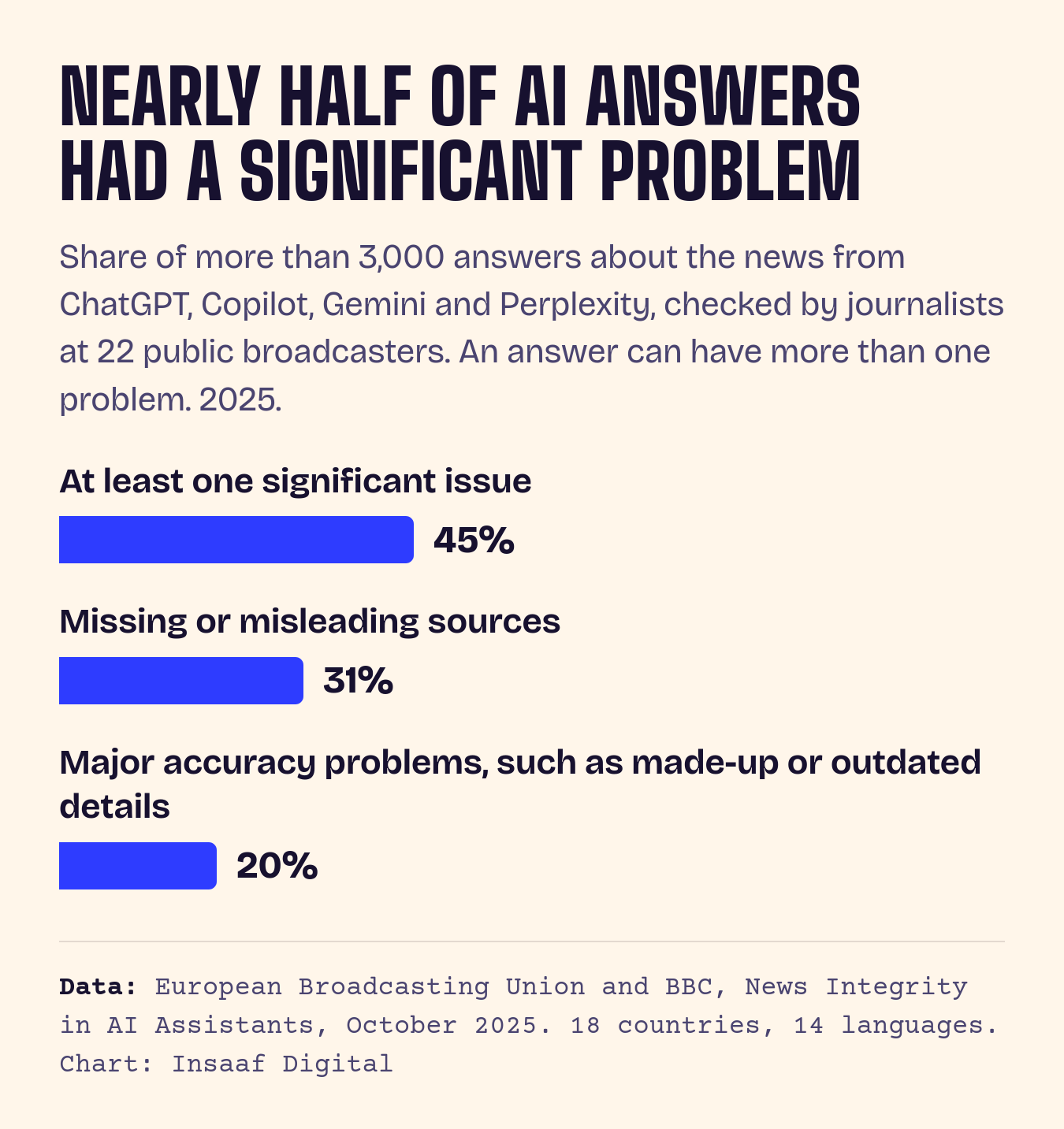
Data: European Broadcasting Union and BBC, News Integrity in AI Assistants.
The tools don’t warn you when they’ve got something wrong, so a person has to check. Once a draft fits the client’s vision, we spend hours perfecting it until it’s good enough to present. The time AI saves on drafting goes back into the work.
Nothing below par reaches a client
If something isn’t good enough, we don’t send it. That’s a first principle, and it takes rigorous testing and review. Clients ask for changes, and we make them. That’s normal. Handing over rough work and waiting for the client to find the problems isn’t.
Researchers at Stanford’s Social Media Lab and BetterUp Labs have a name for what happens otherwise: “workslop”, AI-made work that looks polished but leaves the person receiving it to finish the thinking. In their survey of 1,150 full-time US workers, 40% had received some in the past month. Each case took 1 hour 56 minutes to deal with on average, and about half of the people who received it then saw the sender as less creative, capable and reliable.
Our clients pay for the time we spend on their work, so we don’t hand that work back to them. Review is where people matter most, second only to the ideas and the strategy.
People accept AI’s help when a person is in charge
Audiences draw the line in the same place. In 2025 the Reuters Institute surveyed about 2,000 people in each of six countries about news made in different ways. Comfort was highest for news made entirely by people (62%), then for news where a person leads and AI helps (43%). When AI led and a person oversaw it, comfort halved to 21%. For news made entirely by AI, it was 12%.
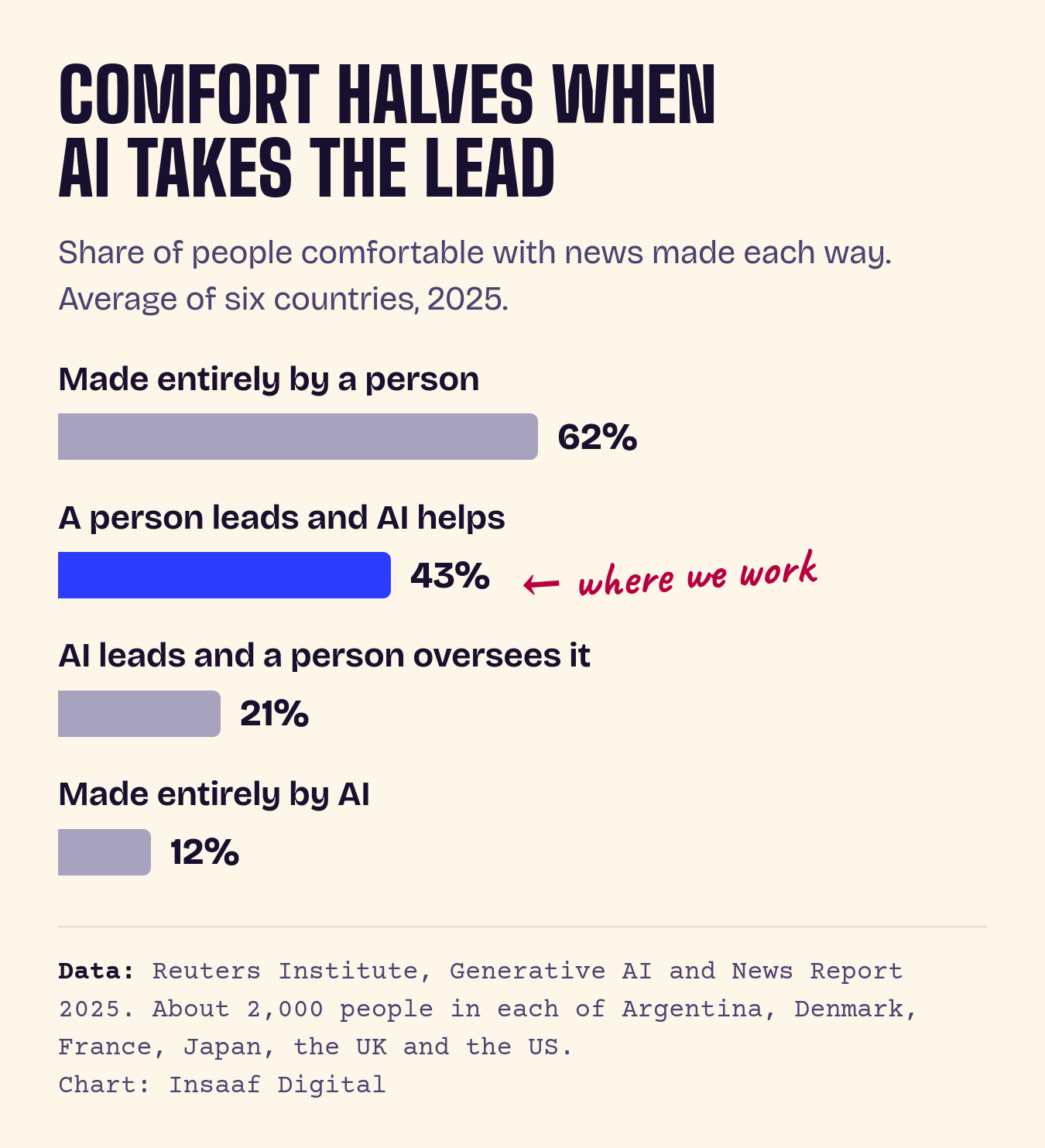
Data: Reuters Institute, Generative AI and News Report 2025.
That’s news, not marketing, but we think the line holds. People are comfortable with AI’s help when a person leads, and that’s how we work.
Ask us where AI touched your work
If you want to know where AI touched your work, ask. We’ll tell you.
That goes for this website too. It was designed and built with Claude, an AI model made by Anthropic. The idea, the story and the final say on every page came from a person, right down to the line on that poster.
It goes for this post as well. Our founder answered questions about how we work. Claude found and checked the research, made the charts and shaped the draft from those answers. Then we edited it and signed it off.
Sources
- Schilke, O. and Reimann, M. (2025). The transparency dilemma: How AI disclosure erodes trust. Organizational Behavior and Human Decision Processes, 188. Summary from the University of Arizona.
- Crestodina, A. (2026). Blogging Statistics 2026: What 1,042 Content Marketers Told Us About What Works. Orbit Media.
- Kennedy, B. and others (2025). How Americans View AI and Its Impact on People and Society. Pew Research Center.
- Google Search Central. Creating helpful, reliable, people-first content.
- Meincke, L., Nave, G. and Terwiesch, C. (2025). ChatGPT decreases idea diversity in brainstorming. Nature Human Behaviour. Summary from the Wharton Mack Institute.
- Dubé, J.-P. and Xu, A. (2026). Large Language Models and Creative Content Design: A Case Study of Email Marketing at Wine Access. Quantitative Marketing and Economics. Summary from Chicago Booth Review.
- European Broadcasting Union and BBC (2025). News Integrity in AI Assistants. See also the EBU press release.
- Niederhoffer, K. and others (2025). AI-Generated “Workslop” Is Destroying Productivity. Harvard Business Review.
- Simon, F., Nielsen, R. K. and Fletcher, R. (2025). Generative AI and News Report 2025: How People Think About AI’s Role in Journalism and Society. Reuters Institute for the Study of Journalism.